Finding the Focus and Creative Freedom with ADHD: How Has Bullet Journalling Helped Me
If you look up the hashtag #BulletJournal on Instagram or Pinterest, you are immediately confronted with a daunting world of artistic perfection. You see flawless, ruler-straight grids, minimalist pastel layouts, and meticulously hand-drawn calligraphy. For the neurodivergent mind, these visual standards don’t inspire organisation—it triggers immediate executive dysfunction and profound guilt. Many of us look at those pristine pages and think: “I will maintain this for exactly four days, lose interest, and feel like a failure.”
As a life coach with ADHD, I am here to tell you that a bullet journal is not an art exhibition. It is not a rigid box you must squeeze your mind into. It is a living, breathing, and unapologetically flexible extension of your brain.
I started my very first bullet journal mid-year in 2017. For nearly a decade, it has been my ultimate survival tool and anchor.
It hasn’t been a linear, flawless journey. During the chaotic year of our divorce and sudden relocation, my journal was completely neglected. When you are managing a crisis, your priority is survival. My creative tools sat in packing boxes for months. But the beauty of a conscious system is that it doesn’t judge you. The moment we officially moved into our self-built home and the dust settled, I unboxed my pens, opened a fresh page, and picked up right where I left off.
When Time Stands Still: The Unfinished Sketch of My Beloved Cat
Because a bullet journal is a raw, unedited mirror of your life, it does not just archive your productivity – it archives your grief. It holds the precise layout of the moments your world shattered.
At the end of November 2025, I sat down to design my December title page. I wanted something cosy and playful, so I took a pencil and sketched a cute grey tabby cat tangled up in a string of glowing Christmas fairy lights. The drawing was inspired by our beloved cat, Kópé. I mapped out the contours with fine pencil lines, prepared the structure for the month ahead, and left the notebook open on my desk.
On the 2nd of December, our reality collapsed. Since February, Kópé had been suffering from a persistent cough that veterinary professionals had repeatedly misdiagnosed as a routine respiratory infection. That afternoon, we finally discovered the brutal truth: the coughing was caused by advanced cardiomyopathy. Just two hours after receiving the diagnosis, Kópé died. It was a tragic, instantaneous shock.
That freezing, bitter evening, I found myself standing in the dark, digging his grave in the icy soil of our garden, unable to comprehend the sheer speed of loss.
When I walked back into the house, I couldn’t bring myself to touch that December cover page. I couldn’t pick up the ink pens to colour in his grey fur or illuminate the Christmas lights around his sketched body. At the end of 2025, I closed that notebook and put it into a storage box with my older journals, the title page entirely unfinished.
To this day, if you open that specific notebook, the transition between November and December feels like a physical fault line where time froze. The pencil lines remain faint, waiting for a completion that will never come. And that is the true, sacred purpose of a bullet journal. It doesn’t demand that you neatly finish every chapter; it simply allows the page to remain raw, bleeding, and beautifully incomplete when life becomes too heavy to draw.
Embracing the Ebb and Flow of Focus
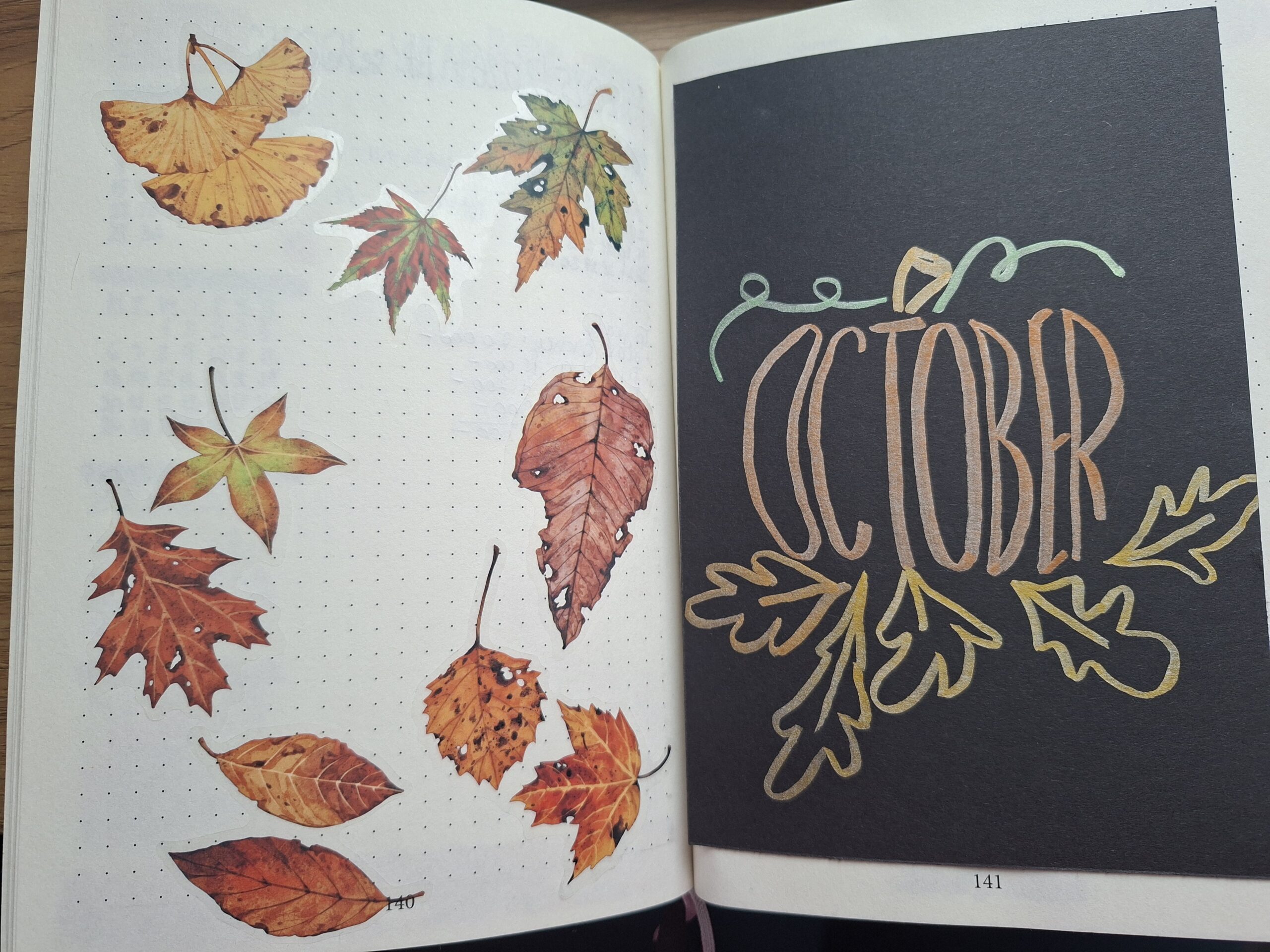
One of the core traits of ADHD is hyper-focus followed by periods of cognitive fatigue. My journal reflects this natural ebb and flow perfectly. There are months where my pages are bursting with artistic layouts, watercolours, and intricate designs. There are other months where it is nothing more than raw, scribbled lists in dark ink.
Both versions are a massive success. The system works because it accommodates my fluctuating energy instead of punishing it. This year alone, I am already punishing my second journal, because the first one was packed to the margins with our lives.
If you want to build a bullet journal that actually protects a neurodivergent mind from mental overwhelm, you must stop treating it as a diary and start treating it as a sensory dashboard. Here is a look inside the tailored modules of my bullet journal:
1. The Unified Calendar & Content Machine
I combine my professional life coaching schedule and my private mother-daughter logistics into a single Monthly Spread. Splitting work and life into separate digital apps is a disaster for time blindness. Alongside this, I map out my content planning and fashion/style/makeup brainstorming for this journal. When a random lifestyle thought strikes my mind at midnight, it is immediately captured on paper. If it is written down, my brain can finally rest.
2. The Esoteric & Botanical Sanctuary
Your journal should nourish your spirit, not just your to-do lists. My notebook acts as a quiet grimoire where I track astrology, moon phases, and the unique architecture of my natal birth chart. It is also filled with botanical notes and herbal remedies. It is a slow, tactile space that connects me to nature’s rhythms, grounding my overactive mind when the digital world becomes too loud.
3. The Kitchen Inventory & Envelope System Support
Good financial sovereignty requires a strong defensive strategy in the kitchen. Until July, my business financial tracking lived in these pages, but I have since externalised it to protect my mental boundaries. Now, the culinary layout focuses entirely on my Monthly Food Brainstorming and an indispensable Food Inventory.
For an ADHD brain, a dark kitchen pantry is an abyss where ingredients disappear. By keeping a strict, physical inventory of what we actually have in our cupboards, I eliminate food waste. This paper list directly supports our physical envelope system, ensuring that when I walk into a grocery shop, I am a strategic operator with zero risk of buying redundant, impulse items.
Reclaim Your Blank Page
If you have a drawer full of half-started, abandoned planners, stop blaming your willpower. Traditional pre-printed diaries fail you because they force you into someone else’s rigid timeline.
Your mind is a beautiful, non-linear, and creative landscape. Buy a notebook with dotted pages. Let it be messy. Let it be artistic in June and completely plain in August. Leave blank pages if you lose momentum, and start fresh on a random Tuesday in November.
You are the sole author of your life. Your bullet journal does not demand perfection – it only asks for your presence.


You May Also Like

Unlocking Your Life’s Zest: Budget-Friendly Coconut Lime Tofu

Halloween vs All Saints’ Day